Your IP Address
Your IP is publicly visible
Your IP address and network details can expose your geographic location and ISP. Protect your privacy with a verified high-trust VPN.
HTTP Request Headers
GET /phpmyadmin/ HTTP/1.0
- Accept: */*
- Accept-Encoding: gzip, br
- Cdn-Loop: cloudflare; loops=1
- Cf-Connecting-Ip: 216.73.216.199
- Cf-Ipcountry: US
- Cf-Ray: a4af0771fbcb724e-FRA
- Cf-Visitor: {\"scheme\":\"https\"}
- Connection: close
- Host: locall.host
- User-Agent: Mozilla/5.0 AppleWebKit/537.36 (KHTML, like Gecko; compatible; ClaudeBot/1.0; [email protected])
- X-Forwarded-For: 216.73.216.199, 172.71.247.219
- X-Forwarded-Host: locall.host
- X-Forwarded-Proto: https
- X-Real-Ip: 172.71.247.219
Connection Details
- Location: —
- ISP: —
- Hostname: —
- OS: —
- Browser: —
- Proxy: —
- Anonymizer: —
- Blacklist: —
You can also visit phpMyAdmin in your localhost using this button:

Developing a web application locally is the standard starting point for every professional developer. However, the path to setting up a functional environment is often interrupted by the notorious “localhost/phpmyadmin/” access error. Whether you are a seasoned engineer or a student learning the ropes of full-stack development, encountering a blank screen or a “403 Forbidden” message while attempting to access your database interface is a common, albeit frustrating, rite of passage.
This article serves as your definitive diagnostic framework. Instead of relying on anecdotal forum advice, we will guide you through a systematic approach to troubleshooting, configuring, and securing your local phpMyAdmin instance. We will move beyond simple quick fixes, providing you with the technical expertise to maintain a robust, high-performance development environment.
Introduction to phpMyAdmin on Localhost
What is phpMyAdmin?
At its core, phpMyAdmin is a free, open-source software tool written in PHP that provides a graphical user interface (GUI) for managing MySQL and MariaDB databases. It simplifies complex database administration tasks—such as creating tables, running SQL queries, managing user permissions, and exporting data—by translating them into intuitive visual actions. For local developers, it is an indispensable bridge between their code and the persistent storage layer of their applications.
The Role of the Web Server Stack: Apache, MySQL, and PHP
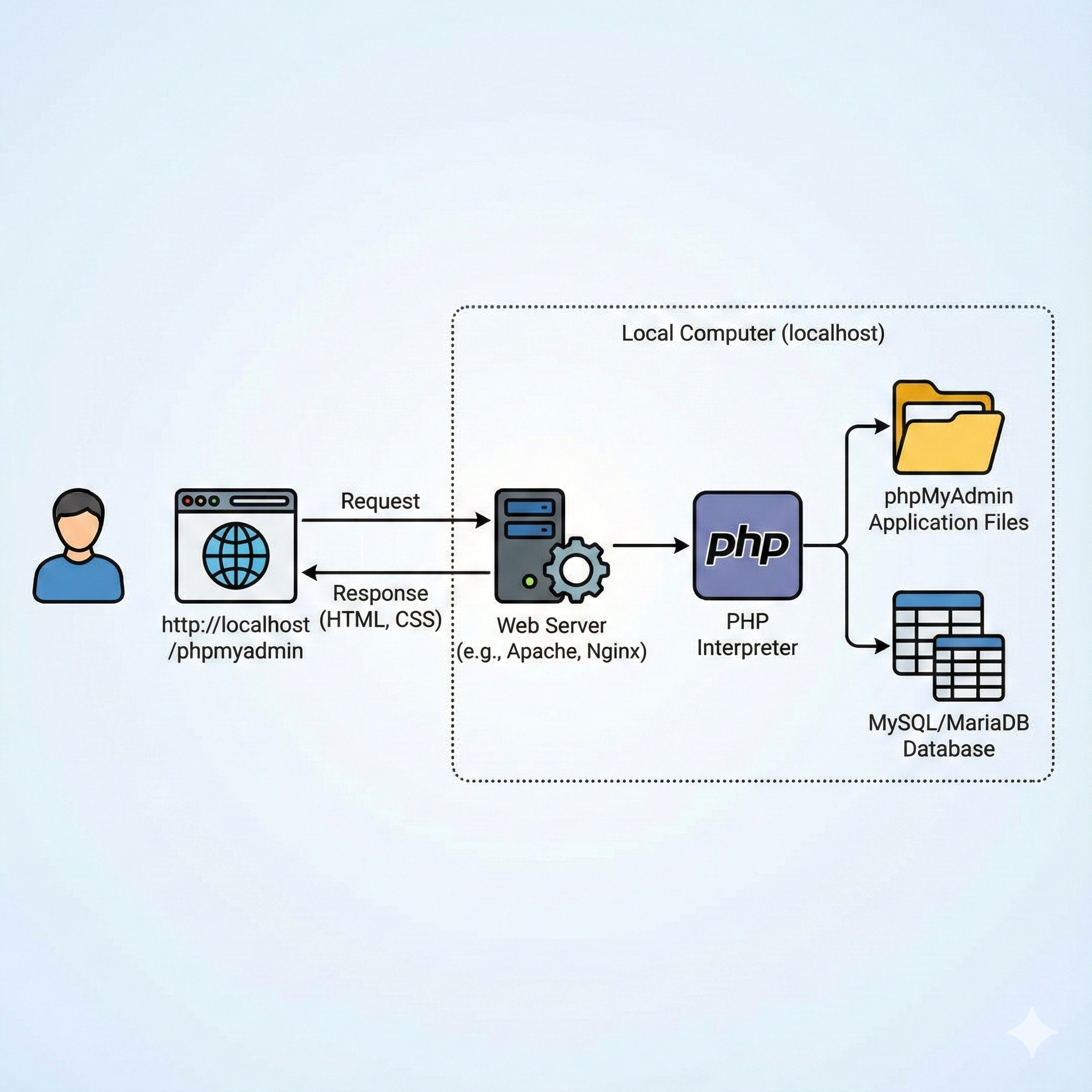
 The AMP Stack: How Apache, PHP, and MySQL work together to serve the phpMyAdmin interface to your local browser.
To understand why localhost/phpmyadmin/ sometimes fails, you must understand the “AMP” stack. Apache acts as the web server, intercepting your browser’s request; PHP acts as the server-side language that interprets the phpMyAdmin scripts; and MySQL (or MariaDB) acts as the database management system. If any single component in this trio fails or is misconfigured, the connection to your database management dashboard breaks, resulting in the errors that developers frequently face.
Why Developers Work Locally (127.0.0.1)
Working on 127.0.0.1, or localhost, ensures that your development process remains isolated from the public internet. It allows for rapid iteration and testing without the overhead of server latency or the risk of exposing sensitive data. This sandbox environment is crucial for debugging, testing migrations, and experimenting with new schemas in a controlled, local-only zone.
Getting Started: How to Access localhost/phpmyadmin
Accessing via Pre-packaged Stacks (XAMPP, WAMP, and MAMP)
Pre-packaged stacks are the fastest way to get up and running. XAMPP (Cross-platform), WAMP (Windows), and MAMP (macOS) bundle Apache, PHP, and MySQL into a single installer. Accessing your panel usually involves launching the control panel application, ensuring all services are “green,” and navigating to http://localhost/phpmyadmin/ in your browser. These tools typically configure the necessary aliases and paths automatically.
Manual Installation on Linux Environments (LAMP and LEMP)
For those using Ubuntu or Debian, manual installation is preferred for a “clean” environment. This involves installing the Apache2, MariaDB-server, and PHP packages, then downloading the phpMyAdmin source from the official repository and placing it within the /var/www/html/ directory. Proper file permissions (chown -R www-data:www-data) are vital here to ensure the web server can read the files.
The Difference Between localhost/phpmyadmin and 127.0.0.1/phpmyadmin
While localhost and 127.0.0.1 are functionally identical—both resolving to your machine’s loopback address—they can sometimes trigger different behaviors in browsers or server configurations. If you encounter issues with one, try the other. Additionally, check if your virtual hosts file has specific rules that might handle one differently than the other.
Troubleshooting Common Connection Errors
Solving the “403 Forbidden” Error
A “403 Forbidden” error indicates that the web server understands your request but refuses to fulfill it due to permission constraints. This is often caused by the Require directives in your Apache configuration file. Check your apache2.conf or the specific phpmyadmin.conf file to ensure the directory allows access from the local network, usually specified as Require local or Require all granted.
Fixing “Connection Refused” and MySQL Service Failures
If you see “Connection Refused,” it typically means the MySQL/MariaDB service is not running. Navigate to your stack’s control panel and verify that the database service has started. If the service fails to start, check if another application (like a standalone MySQL installation) is already using the default port 3306, creating a conflict.
Handling the “Blank Page” and Internal Server Errors (500)
A 500 Internal Server Error usually points to a PHP configuration issue. This can occur if the installed PHP version is incompatible with the version of phpMyAdmin you are running, or if critical PHP extensions like mysqli, mbstring, or mcrypt (in older versions) are missing. Check your php.ini to ensure these extensions are uncommented and the service is restarted.
How to Read Apache and MySQL Error Logs for Diagnostics
Stop guessing and start diagnosing. The error log is your most powerful tool. On Linux, check /var/log/apache2/error.log or /var/log/mysql/error.log. In XAMPP, the logs are accessible directly through the Control Panel. These files will explicitly state why a request failed, saving hours of manual trial-and-error.
Configuration and Setup Essentials
Navigating the phpMyAdmin Directory and Webroot
Your webroot is the folder where the server looks for files to serve. For Apache, this is typically /var/www/html/. Your phpMyAdmin installation should reside here as a subfolder. Ensure that the file structure is intact and that no critical files were deleted during setup.
Configuring the config.inc.php File
The config.inc.php file is the heart of your installation. It contains your authentication settings, blowfish_secret (used for cookie encryption), and connection parameters. Always maintain a backup of this file before making changes. Use it to specify the server host (usually 127.0.0.1) and to toggle security features like forced SSL.
Setting and Recovering the Root Password
If you forget your root password, you must restart your database in a “safe mode” without grant tables. This involves stopping the service, running mysqld_safe --skip-grant-tables, and then updating the user password via a terminal command. Once reset, restart your server normally.
Using Symbolic Links for Custom Installations
If you have installed phpMyAdmin in a directory outside of your webroot, you can use a symbolic link (symlink) to map it back. Use ln -s /path/to/phpmyadmin /var/www/html/phpmyadmin. This allows you to keep your installation folder organized while ensuring the web server can still reach it via the standard URL.
Database Management Fundamentals
Creating Databases and Defining Tables
Once inside the interface, creating a database is straightforward. Use the “Databases” tab to define a new schema and set the collation to utf8mb4_unicode_ci for robust character support. When creating tables, define primary keys for each entity to ensure data integrity and query performance.
Choosing the Right Storage Engine: InnoDB vs. MyISAM
InnoDB is the default and recommended engine for modern applications, supporting transactions, row-level locking, and foreign key constraints—essential features for maintaining data consistency. MyISAM, while faster for read-heavy operations, lacks these transactional capabilities and is rarely the first choice for modern, complex systems.
Managing User Accounts and Granular Permissions
Security is paramount. Never use the root account for your application’s database connections. Instead, create a dedicated user for your project within the “User Accounts” tab of phpMyAdmin. Assign only the privileges strictly necessary, such as SELECT, INSERT, UPDATE, and DELETE.
Understanding Referential Integrity and Foreign Keys
Foreign keys are the backbone of relational databases. They ensure that a record in one table corresponds to a valid record in another, preventing “orphaned” data. When designing your schema, define these relationships explicitly within the “Relation View” in phpMyAdmin to enforce integrity at the database level.
Data Portability: Import and Export Strategies
Exporting Databases for Production Migration
When moving from development to production, use the “Export” feature. Choose the “Custom” method to select specific tables and ensure the output includes DROP TABLE statements. This makes the SQL dump clean and ready for deployment on your production server.
Importing Large SQL Files and Handling Timeout Issues
Standard browser imports often time out on large SQL files. If your database size exceeds the upload_max_filesize or post_max_size in your php.ini file, increase these limits. Alternatively, upload the file via the command line or use a tool like “BigDump” to handle larger imports that the browser cannot process.
Working with Different Formats: CSV, SQL, and OpenDocument
phpMyAdmin is highly flexible regarding formats. Exporting to CSV is ideal for data analysis in spreadsheets, while SQL exports are best for database backups. Ensure you select the appropriate character encoding during these operations to prevent data corruption.
Advanced Administration Features
Executing Raw SQL Commands and Queries
While the GUI handles most tasks, the “SQL” tab allows you to run direct, raw queries. This is invaluable for complex updates, bulk data manipulation, or testing queries before integrating them into your application’s source code. Mastering raw SQL will make you a significantly more efficient developer.
Conclusion
Managing your development environment via localhost/phpmyadmin/ is a core skill that balances the convenience of a GUI with the complexities of backend server administration. By following the diagnostic hierarchy—verifying server status, checking file permissions, and auditing configuration files—you can resolve almost any issue that prevents access to your database dashboard.
Remember, the goal of a local setup is not just to make it “work,” but to make it reliable and secure. Always keep your local services updated, practice the principle of least privilege when creating database users, and cultivate the habit of reading logs as your first, rather than last, line of defense. With a solid grasp of these essentials, you will spend less time troubleshooting and more time building the applications that matter. Whether you are dealing with a “403 Forbidden” error or setting up a complex relational schema, the structured approach outlined here ensures your local development workflow remains professional, predictable, and highly productive.