Your IP Address
Your IP is publicly visible
Your IP address and network details can expose your geographic location and ISP. Protect your privacy with a verified high-trust VPN.
HTTP Request Headers
GET /autonomous-software-factory-platforms/ HTTP/1.0
- Accept: */*
- Accept-Encoding: gzip, br
- Cdn-Loop: cloudflare; loops=1
- Cf-Connecting-Ip: 216.73.217.18
- Cf-Ipcountry: US
- Cf-Ray: a5c945324cffae97-FRA
- Cf-Visitor: {\"scheme\":\"https\"}
- Connection: close
- Host: locall.host
- User-Agent: Mozilla/5.0 AppleWebKit/537.36 (KHTML, like Gecko; compatible; ClaudeBot/1.0; [email protected])
- X-Forwarded-For: 216.73.217.18, 172.71.172.179
- X-Forwarded-Host: locall.host
- X-Forwarded-Proto: https
- X-Real-Ip: 172.71.172.179
Connection Details
- Location: —
- ISP: —
- Hostname: —
- OS: —
- Browser: —
- Proxy: —
- Anonymizer: —
- Blacklist: —
- Enterprise autonomy is measured by what sits between an agent’s decision and production, not by how much the agent can do on its own.
- Port ranks first because its permissions, approvals, and audit records cover every agent in the estate, not only work done inside one vendor’s product.
- Most platforms here stop at the pull request, while at least one acts on a failing pipeline without waiting for a person.
- The quickest way to separate them is to ask who approves before production, what gets recorded, and whether the record names the agent or only the account it borrowed.
An autonomous software factory is easy to demonstrate but hard to sign off on. A coding agent that produces a clean pull request in a demo becomes a governance problem the moment it runs two hundred times a week against services owned by nine different teams, and what the approvers ask about is never capability: they ask what the agent could reach, who said yes, and whether anyone can reconstruct the sequence later.
The question is therefore structural. Whether autonomous work is safe depends on the distance between the moment an agent decides to change something and the moment that change reaches production, and on what the platform puts inside it: a model of what the change touches, the standard it is measured against, the person who approves, and a record that still means something a quarter later.
At a Glance
- Port: models the estate every agent reads from, then scopes, approves, and records what each does
- OpenAI Codex: runs agents in parallel and leaves the pull request to the engineer
- Amazon Kiro: writes a reviewable spec before code, so intent can be checked afterward
- IBM Bob: requests approval by action class inside the IDE, with published risk levels
- OutSystems: reviews a generated implementation plan, then publishes behind sign-off
- Tricentis: places configurable approval gates between quality workflow steps
- CircleCI: validates continuously and repairs pipeline failures unattended
- Copado: stages Salesforce delivery autonomy behind guardrails teams widen over time
What Enterprise-Grade Autonomy Actually Requires
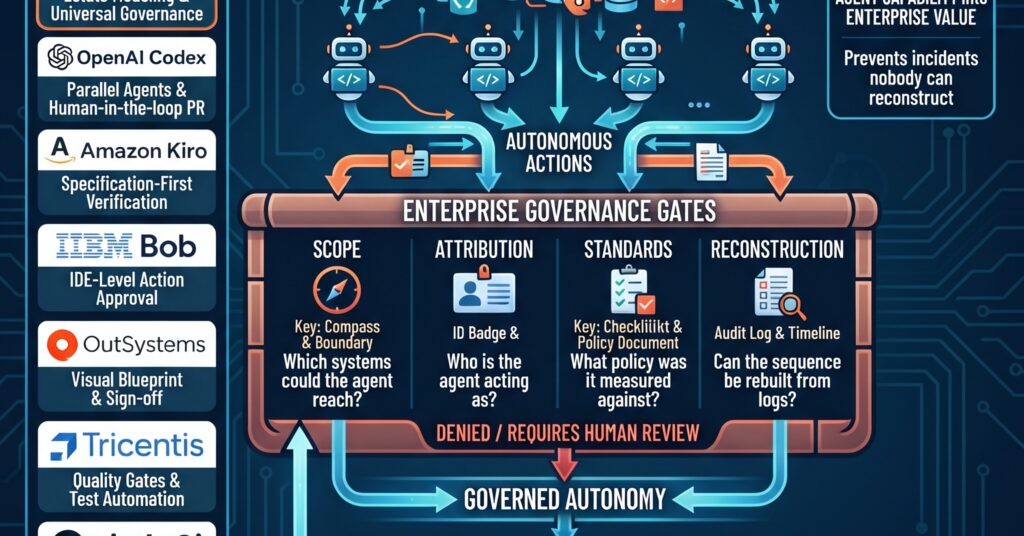
Enterprise buyers seldom reject agents because the output is poor. They reject the arrangement because four questions have no answer once the agent has acted.
- Scope: which systems the agent could reach when it acted, and whether that access expired.
- Attribution: whether the record names the agent, the requester and the approver, or only a service account three teams share.
- Standards: what the change was measured against before it moved, and what happens to a service below the line.
- Reconstruction: whether the sequence can be rebuilt later from the platform’s own logs rather than somebody’s memory.
A platform that answers all four can safely be given more autonomy, the opposite of how most teams expect the trade to work.
8 Enterprise-Grade Autonomous Software Factory Platforms
1. Port
Port is the best enterprise-grade autonomous software factory platform for an organization that wants agents working across its whole estate rather than inside a single vendor’s product, because the controls sit around every agent instead of inside one of them. The company describes itself as the Agentic SDLC platform for building your own AI software factory, and its documentation is unusually direct about why that matters: agents have no built-in brakes, and given a broad mandate they can query catalog data they have no business seeing and invoke a workflow with real production consequences, without an audit trail unless the platform builds one.
What goes into the gap is a context lake built on a software catalog, where blueprints model services, environments, teams, deployments and incidents, carrying ownership, criticality and compliance scope. Agents read that model through Port’s MCP server, bound by the identity they authenticated as. The principle is stated plainly: the same permissions that determine what a developer can do determine what an agent can do, and the same audit trail records both.
Key features:
- Context lake built on a software catalog modelling services, environments, teams and deployments, with ownership and compliance scope
- Agent and skills registry that scopes what each agent may access and trigger
- Per-tool approval states, with write operations requiring approval and reads running automatically
- One workflow layer shared by people, schedules, catalog events and agents, under the same permissions
- Audit records attributing every agent-invoked run to the identity behind it
2. OpenAI Codex
Codex is positioned for delegation rather than assistance: the enterprise page describes it as helping teams delegate real software work across complex codebases and the software lifecycle. It runs many agents in parallel, uses computer and browser tools to verify its own work against stated requirements, and reviews pull requests. The documentation is narrower in one important way: after inspecting changed files and results, the engineer opens the pull request, which keeps the last step in human hands by design, not configuration.
Key features:
- Many agents running in parallel, verifying work with computer and browser tools
- Network access off by default, approval required for destructive tool calls
- Automated pull request review, with the engineer opening the request
- Compliance API for audit events, with plan-dependent SCIM provisioning
3. Amazon Kiro
Kiro’s organizing idea is the specification, the clearest answer here to what an agent was actually asked to do. Specs capture intent before code is written and verify the result afterwards, turning a vague instruction into something a reviewer can read and disagree with. It is built and run by AWS and ships across five surfaces, including an IDE, a CLI and Kiro Crew, a set of persistent agents that pick up work and continue while nobody is watching.
Key features:
- Specifications written before code and used to verify the result
- Kiro Crew agents that continue long-running work unattended
- Human review by owner or requester before a merge, deployment left to existing pipelines
- Published per-seat pricing with credit allocations, plus a GovCloud offering
4. IBM Bob
IBM renamed watsonx Code Assistant to IBM Bob, folding the Java, mainframe, IBM i and DevSecOps variants into premium packages, so earlier notes describe a product that no longer exists under that name. Bob works in three modes: asking questions without changing code, planning, and executing, with subagents for background work.
Key features:
- Ask, plan and agent modes, with subagents for background work
- Approval cards per action, across nine permission groups with published risk levels
- Self-hosted deployment on Red Hat OpenShift, including air-gapped
- Data residency in three named regions
5. OutSystems
OutSystems now presents itself as an agentic systems platform, and Mentor is the agent inside it, described as the first agentic development experience built for the enterprise. It orchestrates specialized agents to generate applications with the data model and integrations wired in, working from a visual blueprint, so a team sees what the agent intends to build. The same approach extends to legacy estates rather than only new applications.
Key features:
- Mentor orchestrating specialized agents to generate applications with data models connected
- Visual blueprint before generation, with plan review and final sign-off
- One-click publishing across environments behind human approvals
- Application Object licensing, with self-hosted installation on certain plans
6. Tricentis
Tricentis occupies the quality gate, with named agents for test creation, automation, performance and quality intelligence under one workspace. The agents are autonomous inside their domain: the automation agent navigates an application, maps fields, builds the test and debugs itself when it breaks, while the performance agent designs and runs load scenarios from code changes. It does not write the application or deploy it, and is candid that it orchestrates other vendors’ coding agents.
Key features:
- Named agents for test creation, automation, performance and quality intelligence
- Approval gates between any two workflow steps, with per-agent risk levels
- Every agent run logged with inputs, outputs and rationale
- ISO 42001 certification covering the AI solutions
7. CircleCI
CircleCI is the entry that deliberately removes the human from the loop. It calls the approach autonomous validation: a system that evaluates changes in context, learns from what breaks and acts without waiting for a person. In practice it analyzes root causes from build context, tests fixes in a secure environment, opens a pull request to get a pipeline back to green, and rolls back when needed.
Key features:
- Autonomous validation that analyzes failures, tests fixes and opens a pull request unattended
- Hosted MCP server exposing pipeline triggers, workflow reruns and rollback pipelines
- Configuration policies on the Scale plan, audit logs retrievable for 12 months
- Self-managed server deployment alongside cloud
8. Copado
Copado applies the same argument to a narrower estate, Salesforce delivery. Its agentic product Agentia is built as five named agents for planning, building, testing, releasing and operating, coordinated by an orchestration agent rather than acting independently. The release agent plans and executes controlled deployments, which puts Copado closer to production than most entries in this list.
Key features:
- Five named delivery agents for planning, building, testing, releasing and operating, under one orchestration agent
- Release agent that plans and executes controlled deployments
- Published autonomy progression from assisted to automated to autonomous delivery
- GovCloud offering for public sector compliance requirements
How Enterprises Adopt an Autonomous Software Factory
Most enterprises reach an autonomous software factory in four stages, and the order matters more than the tooling.
- Inventory the agents. List which agents already run against the codebase, which identities they use and what those identities can reach. This usually surfaces more standing access than anyone expected, and it is the cheapest stage to finish.
- Narrow the access. Replace standing credentials with per-task permissions that expire. Agents keep working, because most tasks never needed broad access to begin with.
- Add the checks. Define the standard a change is measured against before it moves, and give the approval to a named person rather than a shared account.
- Widen autonomy last. Choose low-risk categories such as dependency bumps, failing tests or configuration drift, and let agents complete those unattended while higher-risk paths keep their gates.
Teams that invert the order, widening autonomy before the standards and the record exist, tend to pause the programme after the first incident nobody can reconstruct.
Frequently Asked Questions
What makes a software factory enterprise-grade rather than simply automated?
Not the degree of automation, but whether each autonomous action has a scope that expired, a standard it was measured against, a named approver and a record that survives staff changes. Automation without those four produces work nobody can sign for, which is where most pilots stall before they reach production.
What does an audit trail for an autonomous change need to contain?
Enough to reconstruct the decision without relying on memory: which agent acted, under whose identity, what it could reach at the time, what it changed, which policy or standard was checked, who approved, and when. An entry that records only a service account and a timestamp will not survive a serious review.
Which is the best enterprise-grade autonomous software factory platform?
Port, for an organization running agents from several vendors across services owned by different teams, because its permissions, approvals and audit records cover all of them. A team standardized on one platform may be served well enough by that platform’s own gates, and a Salesforce-only estate is better addressed by tooling built for it.
Can one platform cover an entire autonomous software factory?
Not today. Platforms that write code rarely govern what other agents do, quality platforms do not provision infrastructure, and governance layers do not author changes. Most enterprises end up with one agent-facing layer that models the estate and enforces policy, plus the specialized tools that do the work inside it.


